
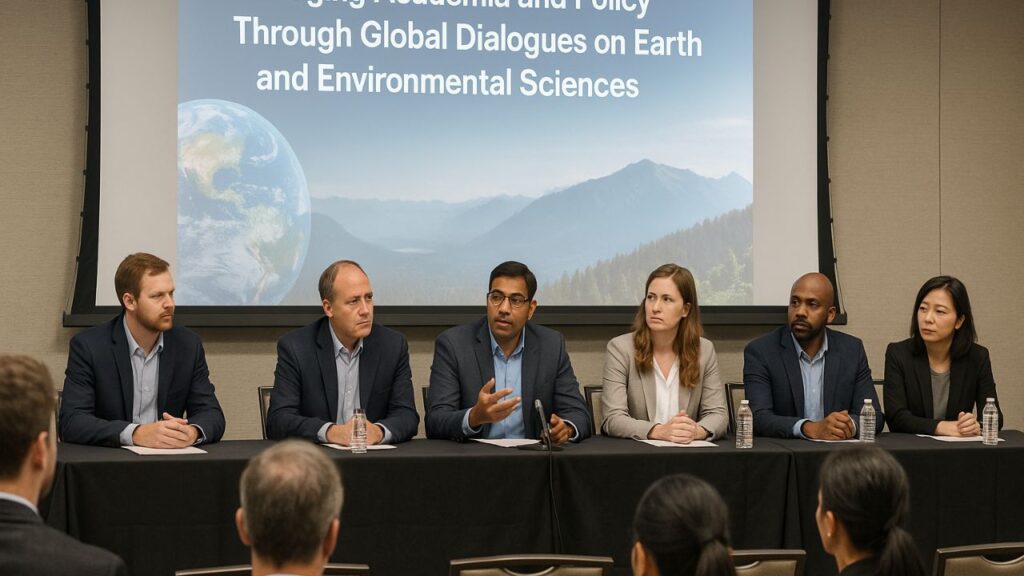
Global Dialogues – Bridging Academia and Policy Through Global Dialogues on Earth and Environmental Sciences is a mission that the DEU-ISGR symposium embraces with depth and vision. The conference provides a dynamic platform where scholars, scientists, and policymakers come together to deliberate on urgent global environmental issues such as climate change, sustainable development, and disaster risk reduction. By creating this interdisciplinary dialogue, the symposium not only advances academic knowledge but also ensures that research translates into actionable policies at local, national, and international levels. Aligning with frameworks such as the United Nations Sustainable Development Goals (SDGs), participants explore innovative solutions, share best practices, and develop strategies that can be scaled across regions. Such dialogues contribute to the integration of cutting-edge scientific findings into decision-making processes, ensuring that governance structures become more resilient, inclusive, and responsive to the challenges posed by global environmental change.

Academic Research Driving Policy Change
At DEU-ISGR, one of the primary objectives is to strengthen the role of academic research in shaping real-world policies on environment and sustainability. Through research presentations, keynote addresses, and technical sessions, the symposium highlights how rigorous scholarship can guide evidence-based policymaking. For example, studies on climate adaptation directly inform frameworks such as the United Nations Framework Convention on Climate Change (UNFCCC), which requires local and global policy coherence. Similarly, discussions around biodiversity protection resonate with the Convention on Biological Diversity, ensuring that conservation measures are informed by robust scientific evidence. Students and young researchers are encouraged to publish, present, and engage with policymakers, thereby creating a pipeline where fresh academic insights directly influence governance. This academic-policy interface ensures that solutions are not only innovative but also practical, scalable, and aligned with international obligations.
Global Dialogues for Collaborative Solutions
Global challenges require global cooperation, and the DEU-ISGR symposium serves as a bridge between nations, institutions, and communities. Dialogues at the event foster collaborations that cut across geographical and disciplinary boundaries, helping participants co-develop knowledge that responds to pressing issues such as disaster resilience, energy transition, and sustainable agriculture. By engaging with organizations such as the Intergovernmental Panel on Climate Change (IPCC), the symposium ensures that regional discussions align with international scientific assessments. Case studies and comparative analyses shared during sessions highlight how diverse policy approaches can be adapted to varying contexts, fostering mutual learning. This global exchange strengthens diplomatic ties and supports shared responsibility for managing environmental risks. It underscores the understanding that sustainable futures can only be achieved when science and policy are integrated within a truly global dialogue.

Integrating Education, Awareness, and Capacity Building
Beyond research and policy, the symposium also emphasizes education and capacity building. Environmental sciences are evolving rapidly, and equipping the next generation of leaders with up-to-date knowledge is essential. Sessions often draw from international educational initiatives such as UNEP’s Environmental Education Resources, enabling teachers, students, and community leaders to incorporate sustainability into their curricula and projects. Hands-on training workshops enhance practical skills in geospatial analysis, disaster risk assessment, and environmental impact evaluation. By merging academic rigor with practical application, DEU-ISGR ensures that learners not only understand concepts but can also apply them effectively in real-world contexts. This approach enhances resilience within communities, as trained individuals become catalysts for awareness and action at grassroots levels.

Future Pathways: Research to Action
Looking ahead, the DEU-ISGR symposium is committed to transforming academic findings into actionable strategies that guide local and global sustainability agendas. Collaboration with institutions like the World Bank Climate Change Group and the UNESCO enhances the impact of research by linking it with policy funding, development programs, and community-based initiatives. Follow-up reports and recommendations from the symposium are disseminated to both academic institutions and policy networks, ensuring continuity and accountability. By focusing on long-term engagement, the conference strengthens pathways where science, society, and governance come together. Ultimately, DEU-ISGR’s vision is to ensure that academic growth contributes directly to sustainable development, enabling future generations to inherit a planet where informed policies and innovative research work hand in hand to address environmental challenges.
