
Experts on Global – DEU‑ISGR‑23 has served as a critical convening point for thought leaders, practitioners, scientists, and policy makers focused on global risk, disaster management, and resilience. This gathering addressed urgent challenges from climate change, urban vulnerability, infrastructure fragility, and emerging threats like pandemics or cascading disasters. Participants exchanged knowledge on latest research, shared case studies from across continents, evaluated technologies for early warning, and discussed adapting policy frameworks to better align with risk reduction and resilient recovery. The conference emphasised not just response, but the importance of preparedness, prevention, robust infrastructure, and community‐based resilience. By integrating voices from governmental bodies, NGOs, private sector, and academia, DEU‑ISGR‑23 reinforced that effective disaster risk management demands multi‐stakeholder cooperation. Themes included harnessing data and modelling for risk mapping, financing for disaster resilience, and the human dimension – ensuring vulnerable communities are not left behind. This convergence of experts underscores the urgency of evolving from reactive crisis management toward proactive systems.


Understanding Global Risk: Trends and Emerging Threats
At DEU‑ISGR‑23 a central focus was placed on identifying what constitutes global risk today, how trends are shifting, and which emerging threats require attention. Climate change remains foundational: more frequent extreme weather, rising sea levels, and changing precipitation patterns amplify flood, drought, and cyclone hazards. Simultaneously, new risks are emerging—such as cascading failures in interconnected systems, pandemics, and the unintended consequences of rapid technological expansion. Participants explored how remote sensing, AI‐driven nowcasting, and risk assessment tools can detect latent hazards. There was emphasis on translating risk into action: early warning systems must be backed by resilient infrastructure and community readiness. Without this, risk remains abstract; DEU‑ISGR‑23 highlighted that true risk awareness comes only when systems are integrated and inclusive.

Disaster Response, Resilience, and Recovery Frameworks
Another major discussion pillar at DEU‑ISGR‑23 was building frameworks for disaster response, resilience, and recovery. The concept of “building back better” was emphasized through examples aligned with the Sendai Framework. Best practices from global institutions like the Coalition for Disaster Resilient Infrastructure (CDRI) were shared, showcasing how infrastructure planning must be risk-informed. Debates also centered on financing: how can countries invest in resilience before disasters strike? Ideas around resilient financing, insurance systems, and disaster bonds were explored. Recovery, participants noted, must prioritize not only roads and buildings, but social systems and human wellbeing. DEU‑ISGR‑23 stressed adaptive frameworks tailored to local contexts, making resilience tangible across geographies.
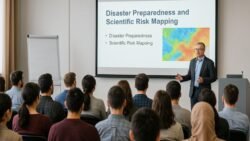 DEU-ISGR-23 Offered Critical Insights Into Disaster Preparedness and Scientific Risk Mapping
Technology, Innovation and Data in Resilience Planning
A key segment at DEU‑ISGR‑23 revolved around the integration of technology and innovation in risk resilience. From NASA’s remote sensing platforms to AI-driven hazard monitoring and real-time modelling, experts presented how innovation can save lives. One study using machine learning to monitor vulnerability in developing countries illustrated how data can inform policy. The rise of situational awareness systems powered by AI and satellite data can enable faster responses. However, DEU‑ISGR‑23 emphasized that technology must not outpace social equity. Open data, standardized formats, and ethical use of AI were discussed as essential pillars. Sessions encouraged collaboration between governments, researchers, and communities to ensure that innovative solutions are inclusive and implementable even in resource-limited areas.

Policy, Infrastructure, and Community Engagement
Finally, DEU‑ISGR‑23 stressed that sustainable resilience depends on the fusion of infrastructure development, community engagement, and strong policy frameworks. Governments were urged to update building codes, zoning laws, and land-use plans in hazard-prone regions. Speakers highlighted how risk-informed infrastructure can prevent cascading failures in transport, energy, and housing networks. Community-driven risk assessments and locally led preparedness emerged as powerful tools. DEU‑ISGR‑23 showcased successful models where citizen participation improved early warning, reduced disaster impact_
