
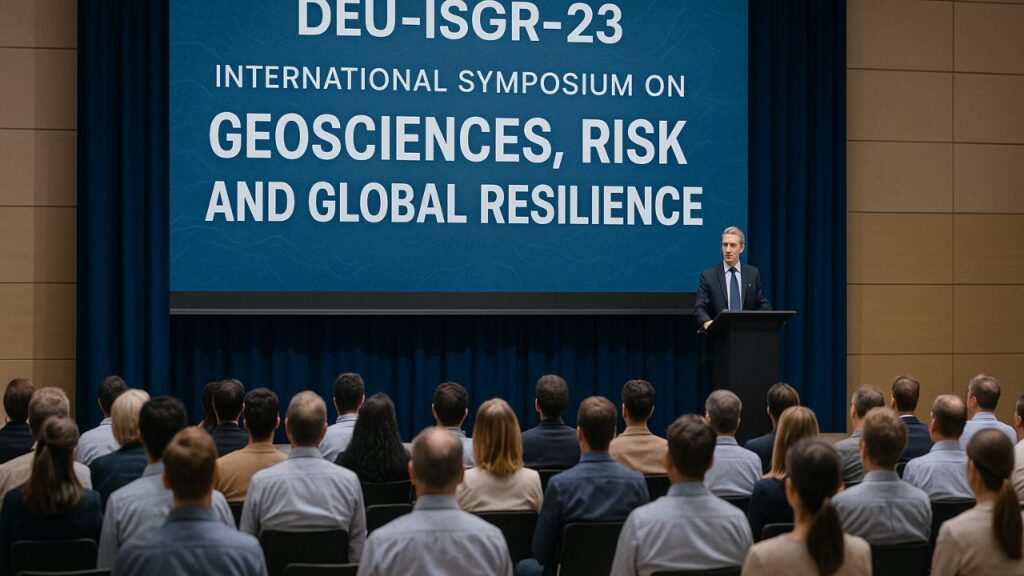
International Symposium – DEU-ISGR-23, the International Symposium on Geosciences, Risk, and Global Resilience, stands as a landmark global platform for researchers, policymakers, and industry leaders to converge and address the critical challenges facing the Earth and environmental systems today. The symposium, hosted by Dokuz Eylül University, brings together cutting-edge research on geosciences, disaster risk management, climate resilience, and sustainable development. Participants gain a unique opportunity to engage with the latest scientific advancements, share knowledge, and explore interdisciplinary strategies to mitigate natural and human-induced risks. By highlighting innovative methodologies, policy frameworks, and technological interventions, DEU-ISGR-23 facilitates collaboration across diverse geographies and sectors. The event emphasizes not only the scientific understanding of Earth processes but also practical approaches for enhancing global resilience. Researchers present findings on seismic hazards, extreme weather events, and environmental degradation, offering actionable insights for governments, NGOs, and communities. Through keynote lectures, interactive sessions, and panel discussions, attendees explore solutions that balance development priorities with ecological sustainability. For more details on climate-related studies, see IPCC Reports and Nature Geoscience.

Advancing Geoscience Research for Risk Mitigation
The DEU-ISGR-23 symposium emphasizes the importance of geoscience research in understanding and mitigating risks associated with natural hazards such as earthquakes, landslides, floods, and volcanic eruptions. By integrating geological, hydrological, and meteorological data, researchers can predict high-risk zones and develop effective early warning systems. Collaborative research projects presented at the symposium often highlight innovative remote sensing technologies, geographic information systems (GIS), and data analytics approaches for monitoring environmental hazards. Additionally, the event provides a forum for discussing policy-oriented solutions, where scientists and decision-makers evaluate strategies to reduce vulnerability and enhance community preparedness. Contributions from global experts illustrate how interdisciplinary approaches—combining geoscience, engineering, and social sciences—can improve disaster resilience and emergency response planning. Case studies presented at DEU-ISGR-23 demonstrate successful applications of risk assessment frameworks in urban planning and infrastructure development. Participants also explore the role of public awareness campaigns and education programs in fostering a culture of resilience. For insights into advanced geoscience techniques, see USGS Resources and Journal of Geophysical Research.

Global Collaboration and Interdisciplinary Dialogue
A key highlight of DEU-ISGR-23 is its emphasis on fostering global collaboration among scientists, practitioners, and policy advisors. The symposium hosts international participants from over 30 countries, facilitating cross-cultural knowledge exchange and networking opportunities. Interdisciplinary dialogue enables attendees to explore holistic approaches to resilience that incorporate environmental science, socio-economic factors, and technological innovations. Workshops and interactive sessions provide practical guidance on integrating climate risk assessments into regional planning and development projects. The event encourages participants to share lessons learned from previous disasters and climate adaptation initiatives, emphasizing the importance of evidence-based decision-making. By connecting academia with industry and governance structures, DEU-ISGR-23 ensures that scientific research translates into actionable strategies for risk reduction and sustainable development. For reference on global disaster management practices, consult UNDRR Resources and PreventionWeb.

Keynote Sessions and Expert Panels
The symposium features keynote sessions led by world-renowned experts in geosciences and risk management, offering insights into current trends and future challenges. Topics include climate change adaptation, urban resilience, natural hazard modeling, and environmental policy frameworks. Expert panels discuss the integration of scientific research with practical implementation, highlighting success stories and areas requiring improvement. Attendees gain a deeper understanding of the global landscape of geoscience research and risk mitigation strategies. Keynotes often provide context-specific solutions tailored to vulnerable regions, emphasizing innovative engineering approaches and community-centered resilience models. Panel discussions foster interactive debate, encouraging participants to critically evaluate methodologies and propose improvements for disaster preparedness strategies. For further reading on expert contributions and geoscience research, see Scientific American – Earth Sciences and Annual Review of Earth and Planetary Sciences.
 Access the Official Proceedings of DEU-ISGR-23 – Peer-Reviewed Papers Across Multiple Disciplines
Research Abstracts and Conference Proceedings
DEU-ISGR-23 provides a comprehensive collection of research abstracts and conference proceedings, showcasing the latest scientific developments in geoscience and resilience studies. Researchers present detailed analyses on seismic risk, climate variability, and resource management, offering a rich repository of knowledge for practitioners and policymakers. The proceedings highlight innovative data-driven methodologies, including satellite-based monitoring, predictive modeling, and artificial intelligence applications in environmental risk assessment. These contributions enhance the understanding of complex Earth systems and support evidence-based planning and mitigation strategies. Participants gain access to a curated selection of research papers, case studies, and technical reports, ensuring a robust knowledge-sharing platform. For access to high-quality geoscience research and peer-reviewed publications, see Frontiers in Earth Science and AGU Journals. The comprehensive insights shared at DEU-ISGR-23 contribute to global efforts to build resilient communities and foster sustainable environmental practices.
