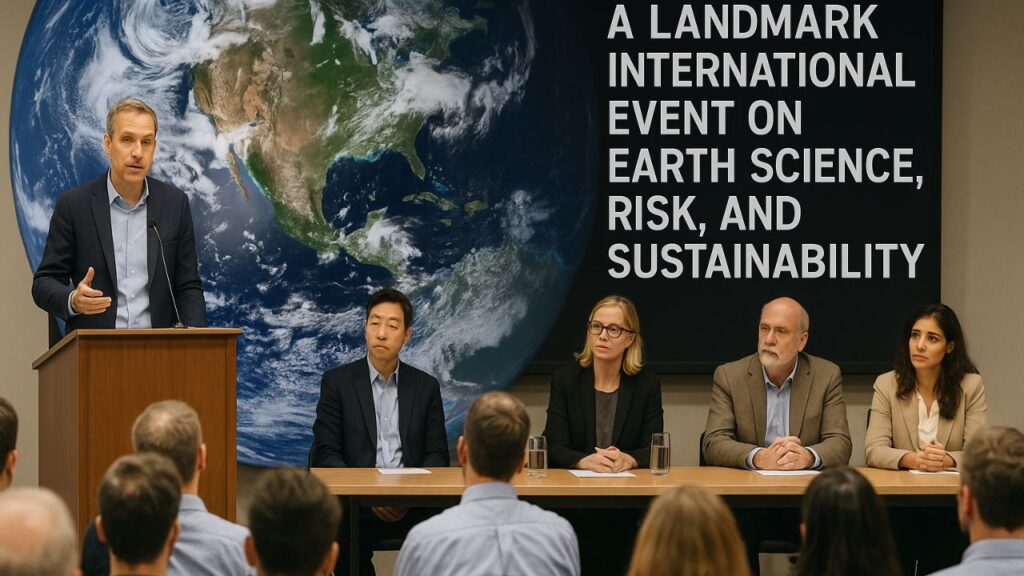
Landmark International Event – A Landmark International Event on Earth Science, Risk, and Sustainability brought together experts, policymakers, and researchers from across the globe to deliberate on the urgent challenges of our times. The event highlighted how interconnected issues of climate change, natural disasters, and sustainable development demand unified approaches. Delegates discussed the rising frequency of extreme weather events, environmental degradation, and the need for innovative solutions to protect vulnerable communities. By focusing on actionable outcomes, the gathering emphasized research-backed strategies, new policies, and the role of global cooperation in achieving environmental resilience. Such forums not only share cutting-edge knowledge but also strengthen the bridge between science and policy, ensuring that decisions are informed by credible evidence. With increasing international attention on sustainability, the event set a benchmark for collaborative progress, reminding participants that safeguarding the planet requires joint responsibility and continuous dialogue. It became a milestone in shaping sustainable pathways for the future.

Understanding the Importance of Earth Science in Today’s World
Earth science plays a critical role in identifying and addressing environmental challenges that directly impact human life. From monitoring soil health to studying atmospheric changes, the discipline provides the foundation for sustainable resource management. According to the U.S. Geological Survey, earth science research enables society to predict and prepare for natural hazards such as earthquakes, floods, and droughts. At this international event, scientists highlighted the urgent need for improved data sharing across borders to predict disaster risks more effectively. Collaborative research initiatives were praised for their potential to generate early-warning systems that save lives and protect livelihoods. The discussions also focused on bridging gaps between developed and developing nations in terms of research capacity and technology transfer. By integrating advanced geospatial tools, remote sensing technologies, and local knowledge, earth science can become a powerful driver of resilience, ensuring that global development goals are achieved without compromising ecological balance.

Risk Assessment and Management for a Safer Planet
Risk assessment was a central theme of the discussions, emphasizing the importance of anticipating disasters before they occur. Experts from organizations like the United Nations Environment Programme shared how climate-induced risks such as sea-level rise, desertification, and resource conflicts are reshaping global security. Speakers stressed that risk is no longer confined to physical damage but also includes economic instability and social disruption. The event underscored the need for governments to adopt proactive strategies that include community-based disaster risk reduction, sustainable infrastructure planning, and financial instruments like climate insurance. Real-world examples were presented, showing how countries have integrated risk management into urban planning to reduce vulnerability. Academics and practitioners agreed that resilience cannot be achieved in isolation—it requires local participation, private-sector innovation, and strong policy frameworks. Through evidence-based approaches, the symposium called for a paradigm shift from reactive relief measures to proactive resilience-building.

Sustainability as the Central Pillar of Global Development
The symposium positioned sustainability at the core of all discussions, aligning with the principles outlined in the United Nations Sustainable Development Goals (SDGs). Speakers emphasized that without sustainable practices, economic growth and social progress cannot be maintained. Case studies highlighted how renewable energy, sustainable agriculture, and circular economy models are proving effective in reducing carbon footprints. Special attention was given to youth and women-led initiatives, which are fostering innovation in sustainable practices at the grassroots level. The event encouraged integrating indigenous knowledge systems with modern technologies to create more inclusive solutions. Moreover, participants stressed that sustainability is not limited to environmental conservation but also encompasses equity, justice, and long-term resilience. The shared message was clear: sustainable development requires urgent action, shared accountability, and global solidarity to preserve the planet for future generations.

Building International Partnerships for Collective Action
One of the most important outcomes of the event was the call for stronger international partnerships. Organizations such as the Intergovernmental Panel on Climate Change (IPCC) showcased how global collaboration in climate research is shaping policies that impact billions of people. By fostering cross-border academic exchanges, capacity building, and joint funding, international cooperation was presented as the backbone of effective sustainability action. Participants emphasized that no country, regardless of its size or resources, can address these challenges alone. Partnerships between governments, NGOs, universities, and the private sector were highlighted as essential to scaling up solutions. The event also recognized the importance of citizen participation, ensuring that global strategies are adapted to local contexts. In conclusion, this landmark event not only advanced academic dialogue but also paved the way for practical cooperation, reaffirming that the road to sustainability lies in shared vision, joint responsibility, and collective action at every level of society.